Disclosure: As an Amazon Associate I earn from qualifying purchases. Some links in this post are affiliate links, meaning I may earn a small commission at no extra cost to you.
My grandfather’s name was Juan. Everyone called him Tito.
He was an early riser, up at 5 am every morning, dressed and ready before the rest of the house had stirred. He had a ritual: he would go to the bakery as soon as it opened, always one of the first customers, and he always asked for the breads that were slightly burned. He loved the crunch, the texture, the char. Then he’d come home and drink his tea. Morning, afternoon, night, tea was constant. He was a man of simple, daily pleasures, and he was completely at peace with that.
But in October, something changed. October was the month of Turrón de Doña Pepa or just Turrón.
He would buy one or two pounds just for himself, not to share with the family, just for him, and he’d eat a small piece every day with his hot tea, rationing it carefully through the month so it lasted. He didn’t eat it quickly or carelessly. He savored it. That was Abuelo Tito’s October ritual, and it never changed.
I got to spend a lot of time with him growing up. We shared so many breakfasts, so many conversations, so many mornings that I didn’t fully appreciate at the time and that I treasure completely now. He taught me things that I only understood later: that family matters more than anything else, that you can show love through sharing food and taking care of the people around you, that simple and consistent beats flashy and occasional. Being present every day matters more than showing up with something grand every once in a while.
When I was finishing culinary school, he got really sick. It was hard to see him that way. But during that time, I made him Turrón de Doña Pepa. He tried it. He approved it.
That was one of the last things I made that he got to taste. A few months later, he passed away.
I dedicate this recipe to him. To my Abuelo Tito, who understood that the best things in life come in small pieces, eaten slowly, with a cup of hot tea.
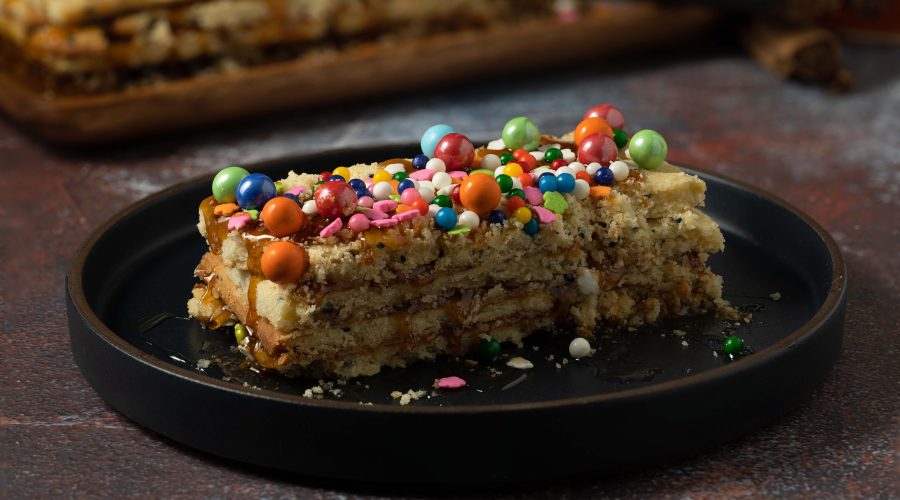
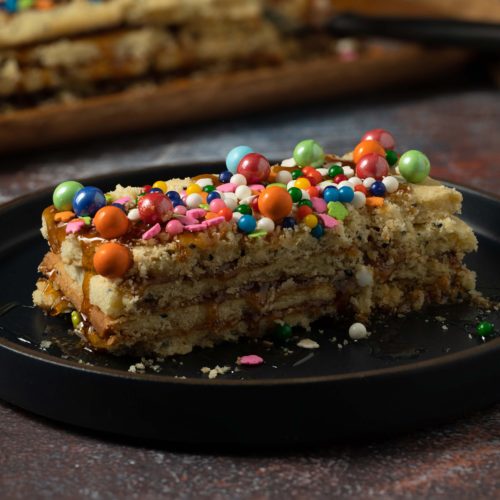
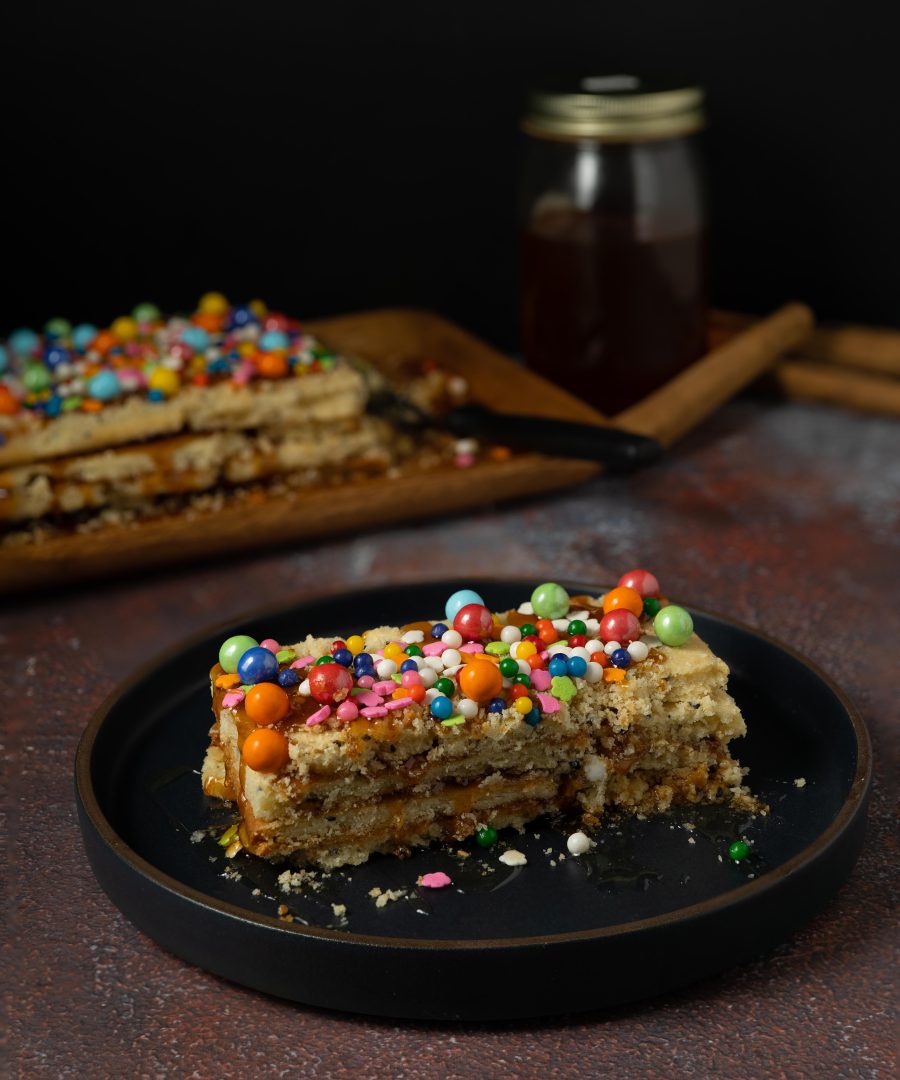
Turrón de Doña Pepa is Peru’s most iconic October dessert, a layered confection made from anise and sesame-flavored shortbread dough, soaked in a spiced chancaca (raw sugar) syrup made with cinnamon, cloves, star anise, orange juice, and fruit, and decorated on top with colored sprinkles and candies.
It’s nothing like the Spanish or Italian turrón you might be thinking of. Those are nougat-based confections, hard or soft, made with almonds and honey. Peruvian Turrón de Doña Pepa is completely its own thing: crumbly, spiced shortbread layers saturated with a dark, aromatic syrup that hardens slightly as it cools and holds the layers together. The texture is unique, somewhere between a cookie bar, a cake, and a very serious piece of candy.
The dessert is named after Doña Pepa Marmanillo, a formerly enslaved Afro-Peruvian woman who, according to legend, regained the use of her arms after praying to El Señor de los Milagros, the Lord of Miracles, in Lima. In gratitude, she created this dessert and distributed it during the October processions. Whether the full legend is historically verified or not, the connection between Turrón de Doña Pepa and October, and specifically with El Señor de los Milagros, is real, deep, and unbreakable in Peruvian culture.
Today, every October, vendors set up along the procession routes in Lima selling turrón by the pound, wrapped in paper, weighed on scales. It’s sold by weight, not by piece which is exactly how my Abuelo Tito always bought it.
If you’re not Peruvian, you may not know what El Señor de los Milagros is, and understanding it helps you understand why this dessert matters so much.
El Señor de los Milagros (The Lord of Miracles) is one of the most important religious and cultural events in Peru. Every October, millions of Peruvians dressed in purple, the color of mourning and devotion, participate in processions through the streets of Lima following a painted image of Christ that survived the 1746 earthquake. It’s the largest Catholic procession in the world outside the Vatican.
October in Lima is purple. Purple clothes, purple flags, purple ribbons. And everywhere the procession passes, Turrón de Doña Pepa follows along.
For Peruvians living in the United States, October and turrón are inseparable from home. It’s one of those foods that carries an entire emotional landscape inside it. You smell the anise and spiced syrup and you’re back in Lima, watching the procession pass, eating turrón from a paper bag.
That’s what this recipe is. Not just a dessert, a piece of October.
Traditional Turrón de Doña Pepa is made by rolling the dough into thin sticks, laying them side by side to form a layer, pouring the syrup over, then adding another layer of sticks on top, and repeating. It’s methodical work.
My version uses sheets instead of sticks you roll the dough into thin flat sheets, layer them with syrup, and build the turrón that way. The result is identical in flavor and texture, but the process is simpler. Less individual sticks to roll, more consistent layers, same delicious outcome.
This is the kind of practical adaptation that happens in every kitchen eventually. You understand the original, you understand why it’s done that way, and then you find the shortcut that gets you to the same place with less frustration.
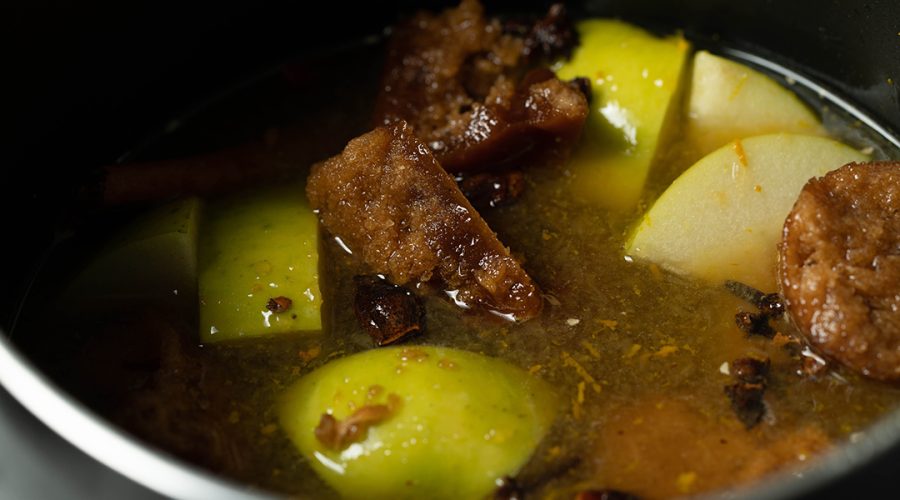
The syrup is non-negotiable. The spiced chancaca syrup with cinnamon, cloves, star anise, orange juice, pineapple, and apple is what makes this Turrón de Doña Pepa and not just an anise cookie. Don’t substitute, don’t skip ingredients, don’t rush it. The syrup is the soul of this dessert.
This recipe requires a few specific tools that make the difference between a frustrating experience and a smooth one.
Rolling Pin: You’ll roll the dough into thin, even sheets. A standard rolling pin works — the longer the better for getting consistent thickness across a wide sheet. [Rolling pin on Amazon]
Rectangle Mold / Frame (no base): This is the key tool for shaping the turrón into the traditional rectangular block. A professional frameless rectangle mold gives you clean, even sides and makes unmolding much easier. You can also use a rectangular baking pan lined with parchment with the bottom removed, but a proper frame mold is worth having. [Rectangle pastry frame mold on Amazon]
Kitchen Scale: This recipe uses grams for most measurements; a kitchen scale is not optional here. Baking by weight gives you consistent results every time, especially with the dough proportions. [Kitchen scale on Amazon]
Heavy-Bottom Saucepan: The chancaca syrup needs to cook low and slow without scorching. A thick-bottomed saucepan distributes heat evenly and prevents hot spots that burn the sugars. [Heavy bottom saucepan on Amazon]
Don’t rush the syrup
The spiced chancaca syrup is the soul of this dessert and it needs time. Simmer it low and slow for at least 20-25 minutes. You want the chancaca fully dissolved, the white sugar incorporated, and the fruit releasing its juices into the syrup. Rushing it with high heat scorches the sugars and gives you a bitter syrup that ruins the whole batch. Low heat, patience, and a heavy-bottom pan.
Work quickly when assembling
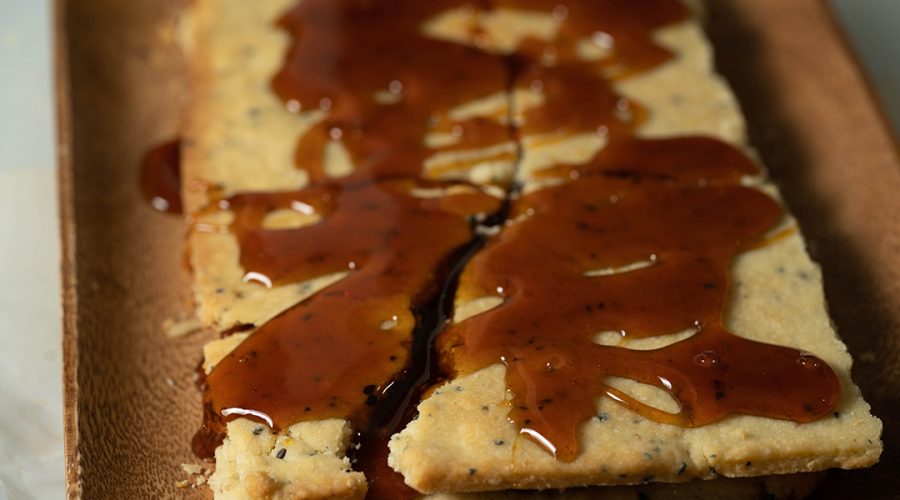
The syrup needs to be warm when you pour it over the layers — it flows into every crack and saturates the dough. If it cools too much it will set before spreading evenly. If you find the syrup thickening too fast as you assemble, warm it gently on the stove for a minute before continuing. Have everything ready before you start: baked sheets cooling, syrup warm, mold in position, spatula at hand.
The sandy dough texture is the goal
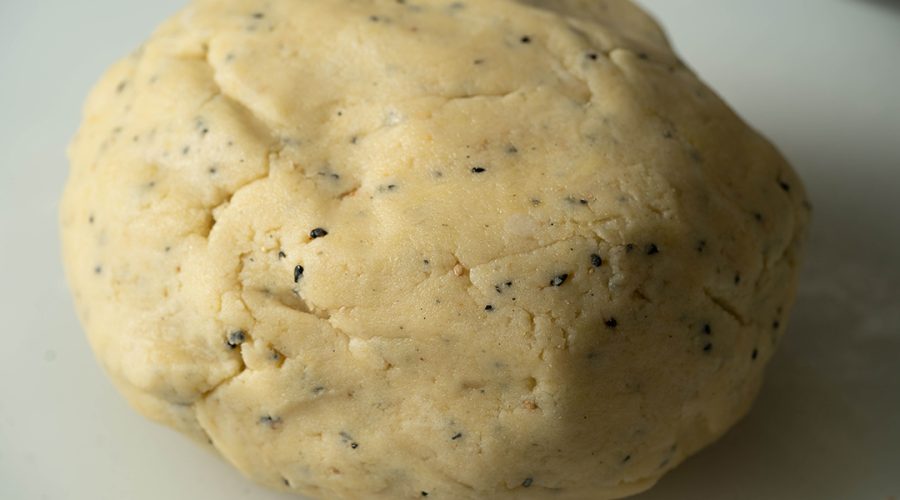
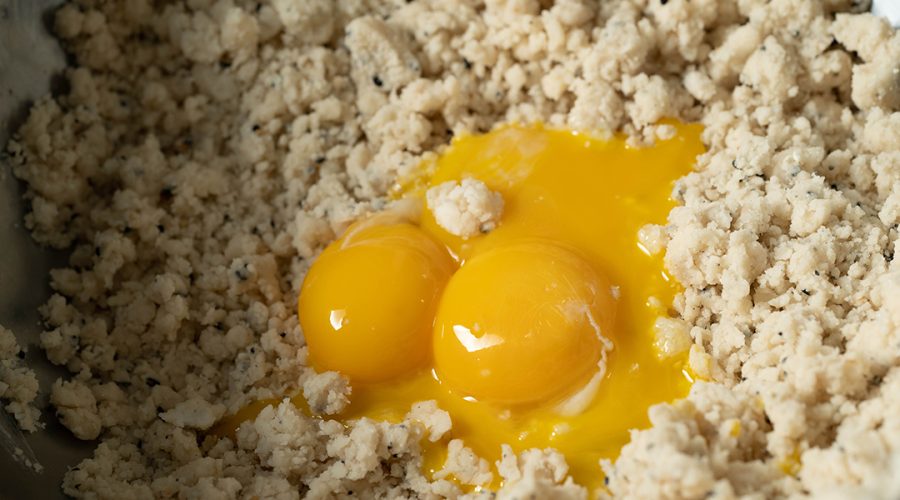
When you’re working the shortening into the flour, you want a sandy, crumbly texture — not a smooth paste, not a cohesive dough yet. This is the same technique used in shortcrust pastry and it’s what gives Turrón de Doña Pepa its characteristic crumbly, melt-in-your-mouth quality. If you overwork the dough at this stage and develop the gluten, the baked sheets will be tough instead of tender. Work quickly, stop as soon as it’s sandy, and let the egg yolks and liquid bring it together.
Rest the dough — don’t skip it
The 15-minute refrigerator rest is not optional. Chilling the dough firms up the shortening, relaxes any gluten that developed during mixing, and makes rolling dramatically easier. Dough that hasn’t rested will spring back when you roll it and be harder to get to an even thickness. Make the syrup while the dough is resting — use every minute of that waiting time productively.
Save every crumb
When you roll and cut the dough sheets to fit your mold, you’ll have offcuts and crumbs. Don’t discard them. Use the larger pieces to patch any cracks or thin spots in your baked sheets before pouring the syrup. Use the crumbs to fill any gaps between layers. The syrup will bind everything together and nobody will know. This is how Peruvian home cooks have always made turrón, nothing goes to waste.
Toasting the aromatics like sesame and anise adds tons of aroma to the dough.
Resting the dough is important; otherwise, you would end up fighting it. 15 to 20 min should be fine
The syrup is just fantastic, you can use it for pancakes, waffles, French toast, ice cream, you name it, it is packed with flavor and aromas.
What to Serve With Turrón de Doña Pepa
The traditional pairing is exactly what Abuelo Tito knew: hot tea. The anise in the dough and the spiced syrup complement tea naturally, black tea, chamomile, or anise tea specifically. The warmth of the tea softens the turrón slightly and brings out the spice notes.
Coffee works too, though the flavor is stronger and can compete with the syrup.
Serve at room temperature, sliced into rectangular portions. Unlike most desserts, Turrón de Doña Pepa is not served warm; it needs to be fully cooled so the syrup has set and the layers hold their shape when cut.
It’s a dessert meant to be shared slowly. Cut it, put it on the table, let people take pieces. This is not a dessert you eat alone in one sitting. Or if you do, you’re channeling Abuelo Tito — and that’s completely valid.
Turrón de Doña Pepa contains dairy (powdered milk) and fruit in the syrup, so it must be refrigerated.
Refrigerator: Wrapped tightly or in a sealed container, it keeps for 3 to 5 days. The texture actually improves after the first day as the syrup continues to be absorbed into the dough layers. At home, as I mentioned in the intro, it never lasted more than 3 hours, but theoretically, 3 to 5 days.
Room temperature: Safe for a few hours at room temperature when serving, but return it to the refrigerator after.
Freezing: Not recommended. The syrup changes texture when frozen and thawed, becoming watery and losing its structure.
Make-ahead: The dough can be made up to 2 days ahead and refrigerated. The syrup can be made the day before and rewarmed gently before using. The assembled turrón is best made the day before serving — overnight in the refrigerator gives the syrup time to fully set and the layers to bind.
Is this the same as Spanish or Italian turrón?
No, completely different. Spanish and Italian turrón is a nougat made with almonds and honey, either hard (duro) or soft (blando). Peruvian Turrón de Doña Pepa is a layered shortbread dessert soaked in spiced cane sugar syrup. The only thing they share is the name. The origin, the ingredients, the texture, the flavor, and the cultural context are entirely different.
What is chancaca and where do I find it in the US?
Chancaca is unrefined raw cane sugar, dark brown, sold in solid blocks or cones, with a deep molasses-like flavor that white sugar or brown sugar can’t fully replicate. In the US, the best substitute is piloncillo, the Mexican equivalent, sold in cone form at most supermarkets with a Latin section and at any Latin grocery store. Look for it in the baking aisle near the sugar. Online it’s widely available. Brown sugar works as a last resort but the flavor is noticeably less complex.
Can I make this without a rectangular mold?
Yes. Line a rectangular baking pan (like a 9×13 inch pan) with parchment paper, leaving overhang on the sides so you can lift the finished turrón out. Build your layers inside the pan the same way. The walls of the pan act as your mold. When fully cooled, lift the parchment, transfer to a cutting board, and slice. The result is slightly less precise than a professional frame mold but completely valid.
Why does the dough use shortening instead of butter?
Shortening gives the dough its characteristic sandy, crumbly texture, what bakers call a “short” texture. Butter has water content that, when it heats and steams during baking, creates layers and lift. Shortening has no water, so it coats the flour particles and prevents gluten development, resulting in that tender, melt-in-your-mouth crumble. Substituting butter will give you a different texture that’s closer to a cookie than to traditional turrón.
Why is Turrón de Doña Pepa only sold in October in Peru?
Turrón de Doña Pepa is deeply tied to El Señor de los Milagros and the October processions in Lima. According to tradition, the dessert was created by Doña Pepa Marmanillo as a thank-you offering to the Lord of Miracles. Selling it in October during the processions became the tradition, and that tradition has held for generations. It’s available year-round in some bakeries, but October is when it’s everywhere on street corners, at church exits, by the pound, wrapped in paper. It belongs to October the way panetón belongs to December.
Can I add other decorations on top?
Yes, the traditional decoration is colored sprinkles and small candies, which is exactly what you see in Peruvian bakeries and street vendors. Some versions also add dried fruit, gummy candies, or chocolate sprinkles (for a chocolate Turron). The colorful, festive top is part of the visual identity of the dessert, it should look celebratory, because it is. Don’t be subtle with the decoration. More is more.
How many layers should it have?
Traditional Turrón de Doña Pepa typically has 3 to 4 layers of dough alternating with layers of syrup, finishing with a top layer of syrup and decoration. More layers mean a taller, more impressive turrón but also more work. Three layers is the practical minimum to get the full flavor experience; the ratio of dough to syrup needs to be right. With fewer layers, the syrup dominates; with too many, the dough gets thick, and the syrup can’t penetrate properly.
Tried it? Let me know.
Leave a rating and a comment below — it helps other cooks find this recipe, and I read every single one.